How Breweries Can Reduce Their Energy Bill and Carbon Footprint
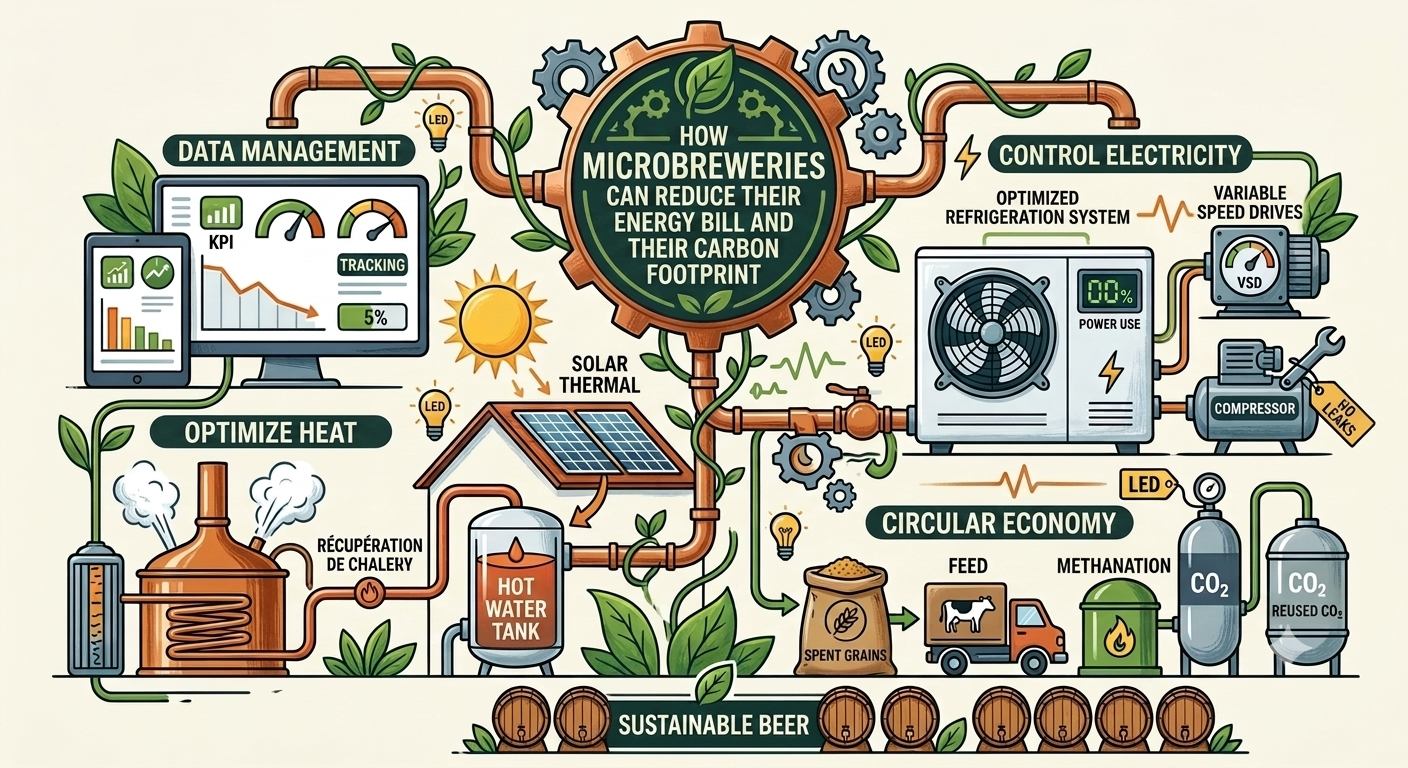
The craft brewing sector is booming, but it is also particularly resource-intensive. Between the heat required for brewing and the cooling needed for fermentation, beer production generates a significant energy and carbon footprint. Fortunately, concrete solutions exist to combine a passion for brewing with financial savings and environmental respect.
Here is an overview of the best practices and technologies for decarbonizing a brewery. The challenge? The return on investment, which is often too long: some solutions take several years to become profitable.
1. Data Management: You Can Only Manage What You Measure
Before making heavy investments, the first essential step is to assess your current consumption.
- Track Key Performance Indicators (KPIs): Calculate your specific energy consumption (e.g., in kWh or MJ per hectoliter of beer produced).
- Raise staff awareness: Involve employees in eliminating waste (turning off unused equipment, reporting anomalies). A corporate culture focused on sobriety offers immediate gains at no cost.
2. Optimizing Thermal Energy (Heat)
Mashing, wort boiling, and cleaning installations (CIP systems) account for the majority of a brewery's heat consumption.
- Heat recovery from wort cooling: This is the most cost-effective basic system. The cold water used to cool the hot wort before fermentation comes out warm. This water must be recovered and stored in a hot water tank to be used for mashing the next batch or for cleaning.
- Recovery of steam during boiling: During wort boiling, a large amount of steam escapes. Installing heat exchangers allows condensing this steam to preheat the brewing water or the wort before boiling, drastically reducing the need for gas or fuel oil.
- Integration of solar thermal: Installing solar thermal collectors on the brewery's roof is an option for preheating brewing water or domestic hot water.
- Insulation of equipment: Insulating brewing tanks, steam pipelines, and hot water tanks limits losses due to convection and radiation.
3. Controlling Electrical Energy (Cooling and Motors)
Cooling fermentation tanks, beer storage, and packaging represent the main electricity expenses.
- Optimize the refrigeration system: Fermentation is an exothermic reaction that requires constant cooling. Ensure that glycol distribution lines are perfectly insulated, regularly clean the condenser coils, and finely adjust defrost cycles.
- Install Variable Speed Drives (VSD): Equipping pumps, fans, and bottling lines with variable speed drives allows adjusting the power of electric motors to actual needs.
- Hunt for compressed air leaks: In bottling and kegging, compressed air is omnipresent. Regular maintenance of seals and conduits helps relieve the compressor.
- LED lighting and motion detectors: Switching to low-energy LED bulbs combined with motion detectors easily reduces the electricity bill.
4. Solar Panels: Green and Profitable Energy
Solar panels represent an effective solution to reduce dependence on fossil fuels. Brasserie Léman (Haute-Savoie, France) has installed photovoltaic panels on the roof of its production building. The electricity produced covers a large part of daytime needs, precisely when packaging machines, lighting, and transfer pumps are most active.
5. Circular Economy and Industrial Symbiosis: Valorizing Waste
A sustainable brewery not only saves energy but also reintegrates its by-products into the economic cycle.
- Valorization of spent grain: Spent grain represents the most significant solid waste. The classic solution is to give or sell it to local farmers for livestock feed. Another option is methanization to produce biogas.
- Capture and reuse of CO₂: Breweries can invest in CO₂ purification and liquefaction systems to recover this gas and use it for carbonation or bottling.
Inspiring example: De Halve Maan Brewery (Bruges, Belgium) uses biogas extracted from wastewater to produce steam, thus reducing its dependence on fossil fuels.
Inspiring example: La Nébuleuse Brewery (Switzerland) has implemented a system capable of capturing between 90 and 95% of the CO₂ naturally emitted by its fermentation tanks, with a mobile and shared model (notably with a neighboring wine estate for harvests), thus reducing the investment cost for the structure.
6. Yeast Recycling: A Resource Not to Be Wasted
Yeasts are essential microorganisms for converting sugars into alcohol and carbon dioxide during fermentation. After fermentation, a centrifuge can separate the suspended solids in the beer, offering two advantages:
- Recover beer to put it back into production.
- Extract yeasts, whose valorization is being studied for applications in animal feed, nutritional supplements, or cosmetics.
Example: The Silly Brewery (Belgium) produces about 250 tons of residue per year, including yeasts that could be valorized.
Becoming an eco-efficient brewery does not necessarily require transforming your facilities into a futuristic plant overnight. By starting with simple actions (measurement, insulation, leak hunting) and planning medium-term investments in heat recovery, renewable energies, or by-product valorization, brewers can prove that economic performance and environmental commitment go hand in hand for the best!