Becoming a Brewer in Europe: Training, Careers, and Opportunities in the Brewing Industry
A true crossroads of history, science, and tradition, Europe is home to the world's most renowned education and production hubs for training in the brewing and malting professions. From operating bottling lines to designing new recipes, the brewing sector relies on a diversity of skills spanning microbiology, fermentation chemistry, process engineering, and quality control.
Whether through specialized academic programs, degrees in food science, or by starting directly on the production floor as an operator, multiple pathways lead to a career in the brewing industry.
1. Access Pathways: From the Field to High Specialization
Access to brewing professions is not limited to specialized engineering degrees. The industry recruits at all qualification levels.
Starting as a Production Operator: The Hands-On Route
Role and Missions: The operator oversees the installations (operating the brewhouse, monitoring fermentation, filtering, kegging, and bottling lines). They rigorously apply hygiene (HACCP) and food safety protocols.
Short Training and Certifications: Qualifying programs (such as the CAP "Conducteur d'installations de production" in France, professional diplomas for food industry operators from centers like Forem/FormAlim in Belgium, or the DU "Opérateur de Brasserie" at the University of La Rochelle) quickly prepare students for the realities of the job.
Internal Career Progression: Through teamwork and hands-on learning with automated equipment, an operator can advance within the brewery to roles such as team leader, packaging manager, or assistant brewmaster.
Through the General Food Industry Sector
It is not essential to follow a 100% beer-focused program from the start. A general degree in food science or biotechnology offers versatility appreciated by employers.
Technicians and Technologists: Graduates in biochemistry or food processing (BTS/BUT in Biological Engineering, BTSA in Quality and Food, or Bachelor's in Agro-Industries) have the theoretical foundations necessary for yeast microbiology and fermentation process monitoring.
Food Engineers: General engineering programs in the food sector provide expertise in fluid management, thermodynamics, and industrial engineering. These skills enable graduates to join R&D, quality control, or production management in large brewing groups.
2. Leading Schools and Specialization Centers in Europe
For candidates seeking high-level specialization in brewing engineering or brewing technology mastery, several European institutions are benchmarks:
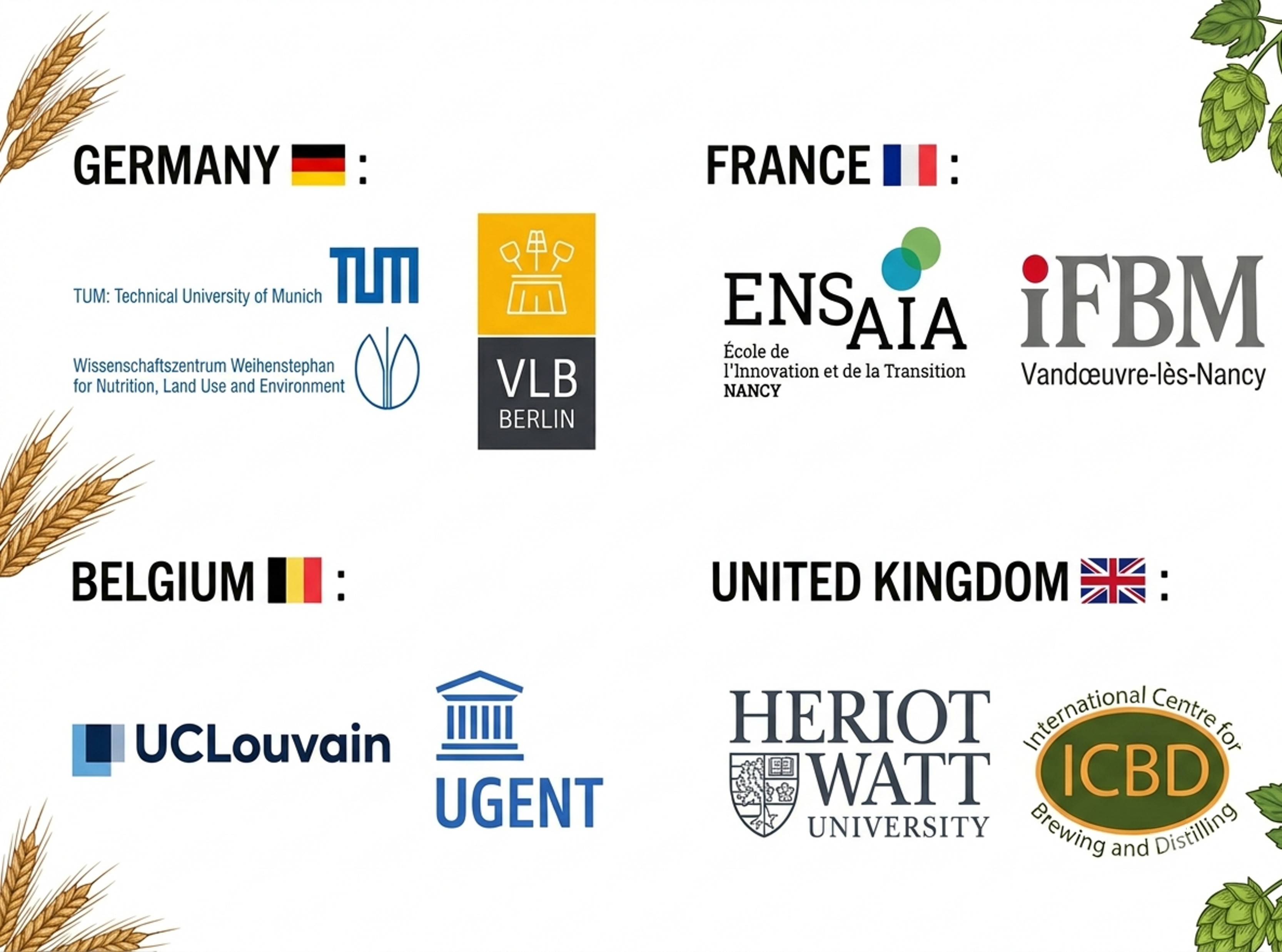
🇩🇪 Germany: Academic Tradition and Technical Rigor
- TUM Weihenstephan (Munich): Affiliated with the Technical University of Munich, this institution is a global academic temple of brewing. It offers Bachelor's and Master's degrees in Brewing and Beverage Technology (Brauwesen und Getränketechnologie).
- VLB Berlin: A research and applied training institute founded in 1883. It is renowned for its Certified Brewmaster Course (taught in English) and its comprehensive Braumeister program.
🇫🇷 France: Process Engineering and Scientific Hub
- ENSAIA (Nancy): The École nationale supérieure d'agronomie et des industries alimentaires (University of Lorraine) trains engineers specializing in brewing and malting. It also offers an international Master's in Brewing Science and Engineering.
- IFBM (Vandœuvre-lès-Nancy): The Institut Français de la Brasserie et de la Malterie collaborates with universities and industry to provide continuing education, research, and laboratory analysis.
🇧🇪 Belgium: Centuries-Old Expertise and Continuing Education
- CERIA / Haute École Lucia de Brouckère (Brussels): A historic reference in technical education in Brussels, CERIA (via INIF - Institut National des Industries de Fermentation) trains technicians and bachelor's degree holders specializing in medical biology, applied chemistry, and fermentation technologies.
- UCLouvain (Louvain-la-Neuve): Building on its Brewery and Fermentation Industries Laboratory, UCLouvain offers a university certificate as well as modules integrated into bioengineering programs.
- UGent (Ghent): Offers the Master of Science in Brewing and Fermentation Science (1 year, in English), with a strong focus on R&D and yeast microbiology.
🇬🇧 United Kingdom: Engineering and Distillation
- Heriot-Watt University (Edinburgh, Scotland): The International Centre for Brewing and Distilling (ICBD) offers Bachelor's and Master's programs covering both brewing and distillation.
3. Career Prospects and Industry Opportunities
Opportunities are mainly divided into four types of structures:
- Large-Scale Industrial Breweries: Seek profiles capable of operating highly automated lines, ensuring compliance with sanitary standards, and maintaining product consistency at large volumes.
- Craft Breweries and Microbreweries: Require high versatility, from milling to bottling, including equipment cleaning and direct production management.
- Suppliers of Raw Materials and Equipment: Careers in malting, hop and yeast selection, or the design of brewing installations.
- Laboratories and Control Bodies: Food safety audits, microbiological analysis, and technical consulting.
What if it were you or someone you know?